



If you ask a Barbadian who they are, the answer may seem obvious.
Yet beneath that simple question lies one of the island’s longest and most fascinating journeys.
For centuries, Barbados was known as Little England. Many families proudly described themselves as British subjects. Barbadians fought in Britain’s wars, studied in British universities, celebrated royal occasions, and built institutions that reflected British traditions. For generations, that identity felt natural.
Yet another history existed alongside it.
Barbados was Britain’s first fully developed slave society
The wealth generated from its sugar plantations helped build an empire while leaving scars that still influence conversations today. African traditions survived against extraordinary odds. New Caribbean identities emerged. Independence in 1966, followed by the transition to a republic in 2021, marked important milestones in an identity that continues to evolve.
None of these histories cancels the others.
They all belong to Barbados.
That complexity has fascinated me for most of my life.
Bajan by Adoption
Although I was born elsewhere in the Caribbean, Barbados has shaped my life for more than fifty years. My mother made Barbados her home, although she was born in Dominica. My grandmother became a Barbadian citizen, and many members of my family are buried on the island. One of my great-uncles, a decorated British officer during the Second World War, later served as Commissioner of Police at the Caribbean headquarters in Barbados.
I am, in many ways, a Barbadian by adoption.
Yet even that description feels incomplete.
Like many people who have lived across several countries, my identity has been formed by family, friendships, education, travel, work, and the cultures that welcomed me. Barbados became one of those homes—not because a passport declared it, but because life did.
Perhaps that is why the island’s own journey with identity has always felt so familiar.
The People Who Shaped This Story
During the years I researched Rogues in Paradise, I met remarkable people whose lives reflected different ways of understanding Barbados.
One elderly gentleman, Woolly Hewitt, looked back warmly on much of the colonial period. His memories were shaped by the world he knew.
Others spoke passionately about Africa as the spiritual source of Caribbean identity, seeing ancestral connections that stretched far beyond Barbados itself.
Still others seemed perfectly comfortable embracing both traditions while simply calling themselves Barbadian.
None of them was entirely right. None of them was entirely wrong.
Identity rarely survives history in a tidy box. Four centuries of migration, slavery, empire, emancipation, education, independence, tourism, and globalisation have woven together something far richer than a single label could ever describe.
History matters. Understanding the past matters.
But history can become dangerous when it is used only as a weapon. Digging into difficult chapters can help us understand one another. Yet when history becomes nothing more than ammunition, anger often follows—and anger has an unfortunate habit of becoming division.
Barbados deserves something better than that.
Which raises a larger question.
If identity can become so complicated for an entire nation… what does identity really mean for any of us?
This essay grew out of the research behind Rogues in Paradise, a book exploring the people, history, and evolving identity of Barbados.
Read Sample Chapters: https://roguesinparadise.com/sample1
Beyond Passports
If you ask me where I’m from, I pause. (i)
There is a tidy answer—passports and paperwork—but it never feels complete.
And perhaps that’s the point.
I was born in one place, raised across others, and have lived long enough in yet another to call it home. I’ve got family stories that drift across oceans and time, DNA results that wink at Vikings and Irish roots, and a life stitched together by friendships, work, and island breezes. None of it, on its own, feels like identity.
And yet all of it does.
When friends and I talk about identity, many say they don’t really have one. They shrug at the question, as though identity is a jersey you either wear or you don’t.
I don’t think it’s that simple.
Most of us carry several identities at once—some inherited, some chosen, some earned through experience. They rise and fall depending on where we are and who is asking. The person who speaks to an immigration officer is not quite the same person who laughs with old school friends. The traveller, the parent, the neighbour, the historian, the entrepreneur—they are all genuine versions of ourselves.
Identity is not fixed. It is lived.
Who Decides Who We Are?
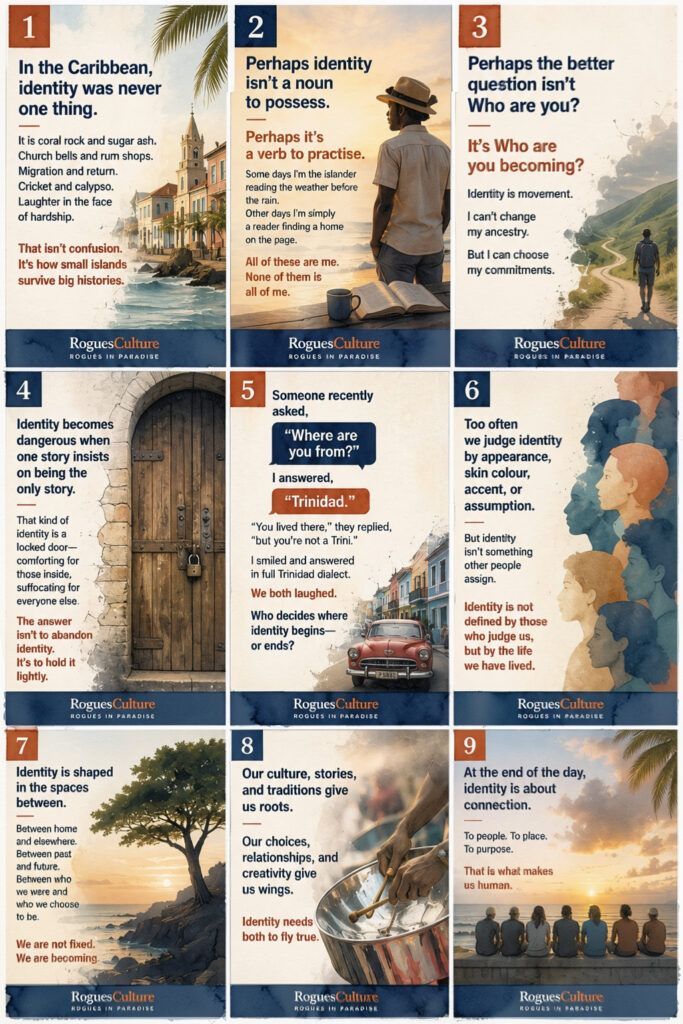
Not long ago someone asked where I was from.
“Trinidad,” I replied.
He looked at me for a moment and smiled.
“You may have lived there,” he said, “but you’re not really a Trini.”
I laughed.
I was born there. I spent my childhood there before leaving for school in Ireland. I returned every summer. My closest friendships began there. Much of my humour and outlook still feels unmistakably Trinidadian.
So I answered him—not with an argument—but in full Trinidad dialect.
He burst out laughing.
So did I.
The conversation changed immediately. It reminded me how often identity is judged by appearance before it is understood through experience
What makes us who we are?
Our birthplace?
Our ancestry?
Our accent?
The colour of our skin?
Our passport?
Or the life we have actually lived?
Perhaps identity belongs less to those who classify us than to those who have walked beside us.
Barbados Teaches Us Something Important
Perhaps this is Barbados’ greatest lesson. Identity does not grow by pretending history never happened. Neither does it flourish by becoming imprisoned by it. Modern Barbados is neither simply Britain’s oldest Caribbean colony nor merely the first Black republic in the English-speaking Caribbean.
It is something richer.
It is coral stone and Atlantic surf. Church bells and calypso. Sugar fields and university lecture halls. Village cricket and international diplomacy.
Old traditions and new ambitions. Its identity has never been one story.
That is not a weakness. It is its strength.
Every day we choose what to remember. Every day we decide whether our identity becomes a bridge—or a wall.
Perhaps the better question is no longer:
Who are We?
But Who are we becoming?
That question leaves room for growth. It leaves room for forgiveness. It leaves room for learning. It reminds us that while none of us can change our ancestry, every one of us can choose our commitments.We can honour where we came from without becoming trapped there.
We can remember honestly without living permanently in yesterday. We can carry history without allowing history to carry us.
That may be Barbados’ greatest achievement.
And perhaps it is one of its greatest lessons for the wider world.
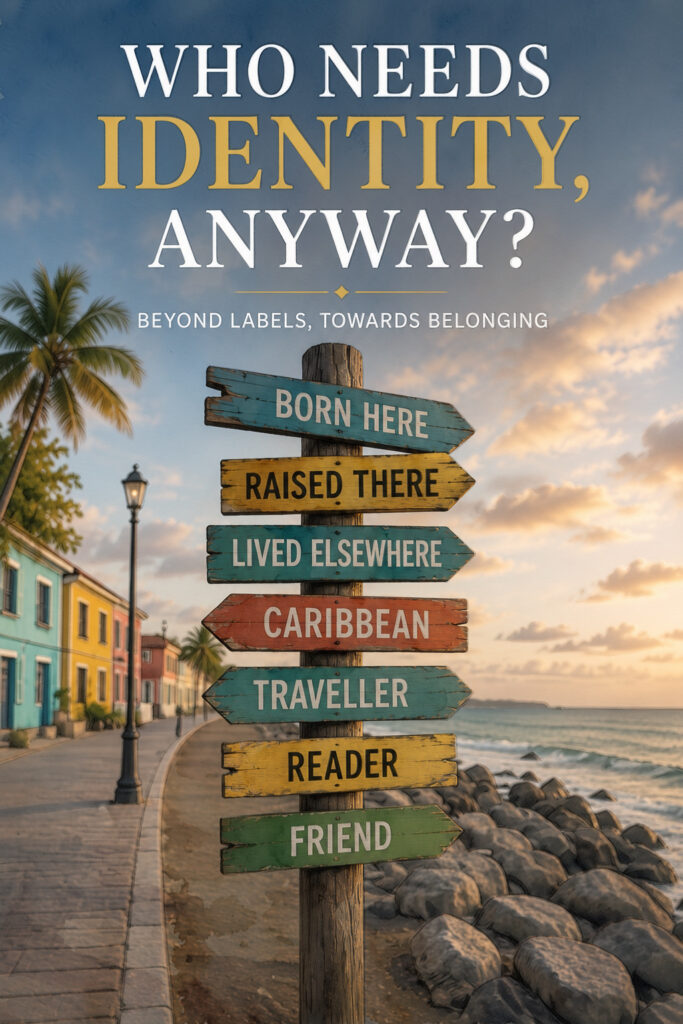
Continue the Journey
These are some of the questions explored throughout Rogues in Paradise—not to provide definitive answers, but to understand how Barbados became the remarkable island it is today.
If this essay resonated with you, it explores just one of the questions at the heart of Rogues in Paradise.
The book follows Barbados’ remarkable journey—from its Indigenous beginnings and colonial past to independence, republic status, and the continuing search for identity in a rapidly changing world. Through history, personal stories, and conversations with extraordinary Barbadians, it asks not only how the island was shaped, but how its people continue to shape its future.
Read Sample Chapter 1 from Rogues in Paradise and discover the story behind the ideas explored here.
▶ Learn more about Rogues in Paradise.
https://roguesinparadise.com/sample1
(c) Ian R. Clayton.
Ian R. Clayton is the founder of Barbados.org, author of Rogues in Paradise, and creator of RoguesCulture. Born in Trinidad and shaped by a lifetime living and working across the Caribbean, Ireland, the United Kingdom, Canada, Europe, and Asia, he writes about Caribbean history, culture, identity, and the changing relationship between people and technology.
Ian R. Clayton — Cultural Storyteller BIO | Rogues in Paradise
| Rogues in Paradise -https://roguesinparadise.com › ian-r-clayton-bio
NOTES:
(i) Beyond Passports and sections following are reflection from who needs identity anyway – first published at
https://roguesinparadise.com/whoneedsidentity
Find your ideal Barbados accommodation...
